


|
|
|
|
|
The integration of Bosch IoT Gateway Software with Azure IoT allows customers to build diverse gateway applications using the advantages of edge computing in combination with the Azure IoT platform capabilities. Azure IoT customers will be able to gain unified visibility into thousands of downstream devices and perform complex data analysis and automation with high volumes of device data locally and from the cloud according to your use case.
What it does
Bosch IoT Gateway Software provides connectivity for devices from a variety of specifications, and offers a unified representation of these devices. An abstraction layer represents the devices and their functionalities in the form of Functional Items (FIs) for applications to use. In addition, the gateway can run logic locally which enables monitoring and automation use cases where data gets processed at the edge.
The Azure IoT integration ensures bi-directional communication between the two which allows you to:
How it works
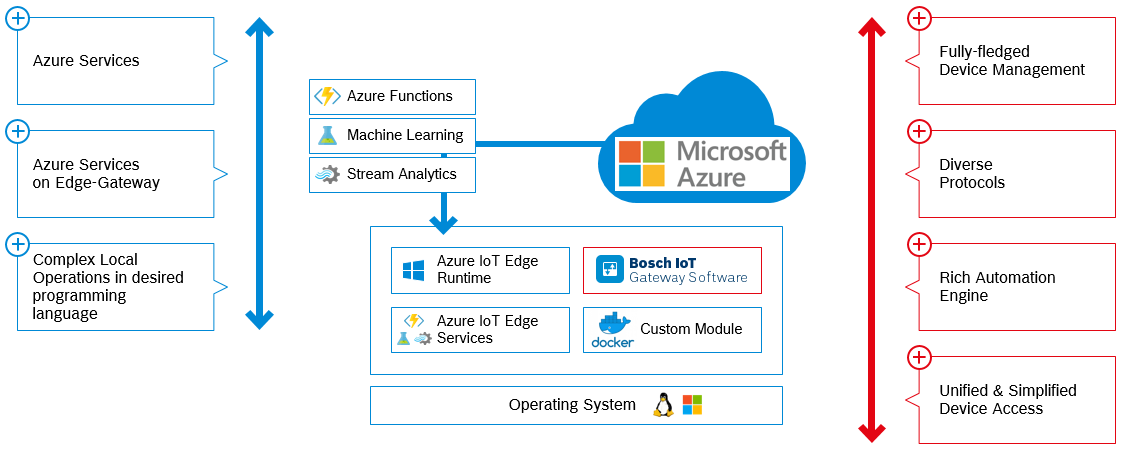
The Azure IoT Edge operates using a container mechanism. Applications deployed on the edge are packed in docker containers called modules. Such modules can be related to Azure stream analytics, machine learning, functions, and other custom applications.
The Azure IoT Edge runtime consists of two modules that are responsible for operation and communication between the applications, as well as to the cloud.
Bosch IoT Gateway gets deployed as an Azure IoT custom module using a docker container image. The Edge Hub is responsible for routing the device messages from the gateway locally and to the cloud.
To perform the integration between Bosch IoT Gateway Software and Azure IoT, users will need to deploy the Bosch IoT Gateway Software as an Azure IoT Edge module, as described in the Setup Guide.
Benefits