


|
|
|
|
|
Bosch IoT Edge Services deploys powerful microservices at the edge – with capabilities that can help you gain domain-specific insights, monitor real-time events and actions, and automate business processes locally.
Edge Services device runtime
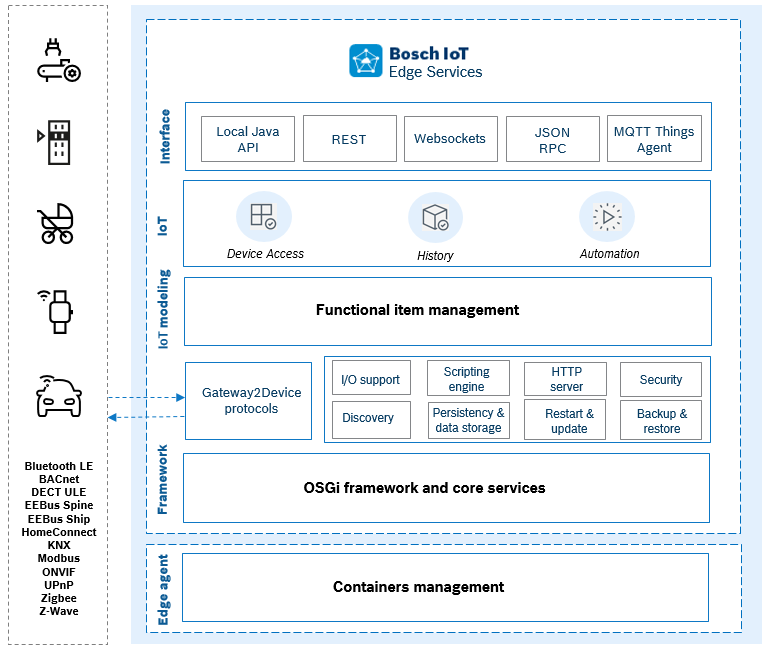
The Edge Services device runtime contains the environment for applications and a collection of functional components. It contains ready-to-use units which you can pick and integrate in an image. You can choose from a rich set of functionalities, such as protocol support, or other functionalities, distributed as one or more bundles and easily pluggable into the OSGi environment.
Edge Services uses the containerized infrastructure of Bosch IoT Edge to bring History, Automation, Device Access and more to the edge, with ability to manage from the cloud.
Framework and core services
This layer represents the "engine" of the SDK, running an OSGi R6 Framework. It contains additional components arranged in modules that provide the core runtime functionality.
IoT modeling
Functional Items Management (FIM) is an abstraction layer that offers the means to model devices and resources using units called functional items. A functional item provides the metadata for things like the actual device, device data, operations, execution of operations, and more.
IoT
This layer contains concrete models of functional items created using Functional Items Management, selected to cover basic IoT scenarios. Such scenarios can include telemetry data or command & control (Device Access); event triggers (Automation); or keeping past data (History).
Device connectivity
Gateway2Device integrates various protocols with the OSGi Framework. These APIs for working with the devices allow you to connect to, control and manage devices either directly through the API or through the abstraction layer provided by the Device Access module.
Interfaces
A number of interfaces (APIs) provide access to interacting with the core essential services. The Things Agent represents the Edge Services runtime as well as all connected edge devices and their capabilities as things with features in the Bosch IoT Things service.
Deployment options
There are various options for building and deploying the Edge Services runtime images.
Using pre-defined target images
Pre-defined images allow you to build a quick proof-of-concept on your target device. A pre-defined target image represents an instance of the Edge Services runtime with a set of pre-selected features so you can easily deploy it for a specific use case and platform. А target runtime image gets installed on the device, best fitting the requirements of the target environment.
Building your own custom image
Using your own custom image gives you better control over what is installed on the runtime images. You can make changes to the image and runtime for any custom requirements that you might have, and then use the modified version when packaging your application. The extensive Edge Services SDK with Eclipse plugins allows you to extend your images with a set of bundles in the runtime, corresponding to various IoT use cases. Modifying the image includes adding, removing files, adding resources, or changing the runtime.
Building the runtime into a docker image
Once you build your image, you can run it as a docker container, using the provided Docker file to build a docker image.