


|
|
|
|
|
Smart Home IP (SHIP) describes an IP based approach for interoperable connectivity of smart home appliances, which covers local SHIP nodes in the smart home as well as SHIP web services and remote SHIP nodes.
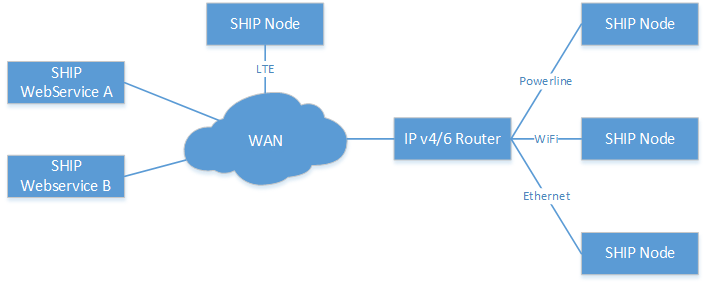
SHIP nodes MAY base on different physical layer approaches, like e.g. WiFi or powerline technologies. An IP router can be used to connect different physical networks and to provide access to the internet, but this is out of scope from the SHIP specification.
On the IP Layer, IPv4 as well as IPv6 are permitted. IP addresses can be preconfigured, assigned via DNS-server, with SLAAC, or by any other appropriate means.
Note: Computationally limited SHIP nodes MAY only support a limited number of connections.
Note: A SHIP node MUST always provide a server port. Only a SHIP node that supports only one simultaneous active connection MAY close the server, to be able to establish a client connection.
In SHIP it is not important which SHIP node takes over the server or client role. If two SHIP nodes try to connect to each other virtually simultaneously, double connections are prevented by the mechanism.
SHIP specific messages conveyed over the established WebSocket connection shall be encoded using JSON.