


|
|
|
|
|
This document provides a brief description of the main components of the History module.
Module Design
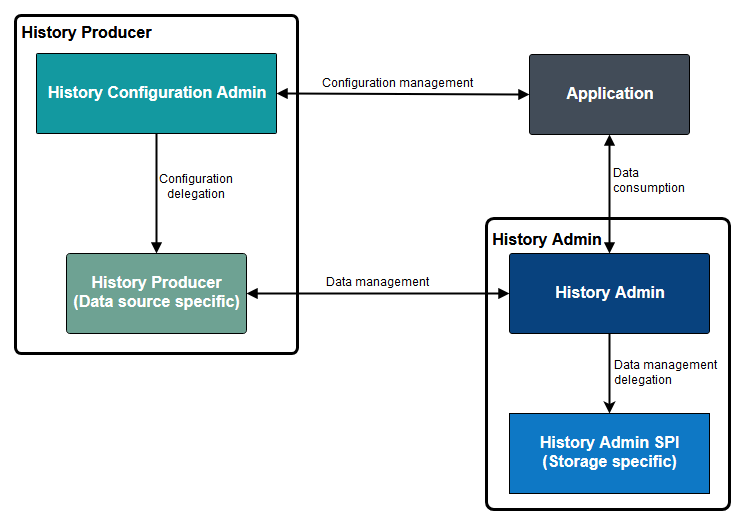
The diagram bellow illustrates the main components, part of the History module.
Application
The Application is responsible for setting up Producers through the History Configuration Admin. Based on this setup, the history data is then collected. The Application can request any desired history entries with a request query. Be aware that only the authorized applications are able to perform these operations.
History Configuration Admin
The History Configuration Admin maintains the history configurations. These configurations are monitored and used by the History Producers. On new history configuration, all configuration listeners added by the Application are notified. At this moment, each History Producer will receive the specific configuration. The existence of configurations does not mean that they will be used by the Producers. The History Configuration Admin is registered as a Functional Item service in the OSGi service registry.
History Producer
The History Producer instances are responsible for producing the form of history entries for the History Admin. This operation can be configured through the History Configuration Admin. When adding a new configuration, the History Producers receives the configuration.
History Admin
The History Admin manages time series data from various sources. These time series are actually sequences of data points. Each data point is represented by a history entry. The History Admin is registered as a Functional Item in the OSGi service registry.
History Admin SPI
The History Admin SPI provides a storage for all history entries. It is registered as a service in the OSGi service registry and this service is used by the History Admin to store and access history entries. When getting entries the History Admin SPI is collecting and returning them.
History Entries
All history data includes the value, timestamp and the associated metadata, including information about the source, in case it is removed from the system.
Each history entry has:
All history queries can be filtered by namespace (via wildcard) and by tokens.